







Generic containers: a 2D array indexed by points, an immutable sorted set and a double-ended queue
- Arrays – a value per
geom.Pointof a size, in one slice, with sides of any integer type. - Sets – immutable sorted sets of any
Compareelement, with union, intersection and difference. - Deques – double-ended queues on a growing ring, pushed and popped at either end in constant time.
The rules behind them are in the package documentation.
go get github.com/gravitton/containerimport "github.com/gravitton/container"An Array[T, S] holds one value for every index of a size in columns and rows. S is the
integer type of its sides and indices, taken from the size it is made with. An array is a handle,
as a slice is: a copy shares its values, and Clone gives storage of its own.
a := container.Arr[int](geom.Sz(4, 3))                  // an Array[int, int], every value zero
small := container.Arr[uint8](geom.Sz[int16](320, 200)) // an Array[uint8, int16], indexed by geom.Point[int16]

a.Set(geom.Pt(2, 1), 7)
*a.Get(geom.Pt(2, 1)) += 1 // a pointer into the array
a.Contains(geom.Pt(4, 0))  // false, the check before Get and Set, which panic outside
a.Size()                   // 4x3; also Width, Height and Len
snapshot := a.Clone() // storage of its ownThe values are stored row by row, and every traversal follows that order: Keys walks the
indices, Data is the storage itself.
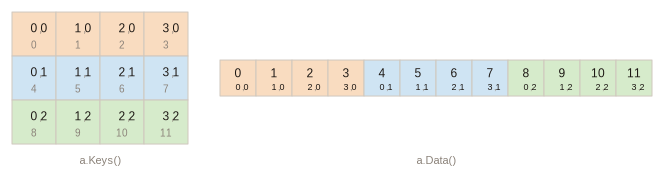
for index, value := range a.All() { // also Keys and Values
	*value += index.X
}

values := a.Data() // the values row by row as a slice into the array, the fastest loop
for i := range values {
	values[i] = min(values[i], 9)
}

data, err := json.Marshal(a)   // {"w":4,"h":3,"d":[…]}, the values row by row
err = json.Unmarshal(data, &a) // and back; an error where the values do not fill the sizeA Set[E] holds any element with a Compare method, once each and in that order. It never
changes: every operation returns a set, so one is safe to copy and share.
a := container.SetOf(geom.Pt(1, 1), geom.Pt(2, 1), geom.Pt(1, 2), geom.Pt(2, 2))
from := container.SetFrom(points) // the same from a slice it takes as its own, without a copy

a.Contains(geom.Pt(2, 1)) // true, a binary search
a.Len()                   // 4; also IsEmpty
a.First()                 // (1,1), true; also Last
a.Index(geom.Pt(2, 1)) // 2, true, the index At reads it back fromEach operation walks both sets once and allocates its result once, or not at all where it equals one of them.
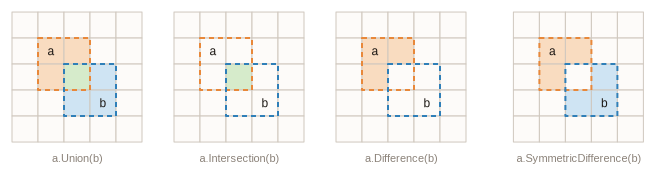
b := container.SetOf(geom.Pt(2, 2), geom.Pt(3, 2), geom.Pt(2, 3), geom.Pt(3, 3))

a.Union(b)               // (1,1) (1,2) (2,1) (2,2) (2,3) (3,2) (3,3)
a.Intersection(b)        // (2,2)
a.Difference(b)          // (1,1) (1,2) (2,1)
a.SymmetricDifference(b) // (1,1) (1,2) (2,1) (2,3) (3,2) (3,3)

a.Intersects(b) // true, without building the intersection
a.Encloses(b)   // false, whether a holds every element of b
a.Equal(b)      // false
A set is walked and stored in its order:
for p := range a.All() { // also Backward
	draw(p)
}

a.Elements()    // a fresh slice; also AppendElements
json.Marshal(a) // [{"x":1,"y":1},…], null for the empty setA Deque[E] holds elements in order from its front to its back and changes in place, so unlike
the other containers it is used through a pointer and never copied, which go vet reports. Its
zero value is the empty deque, ready to use.
var body container.Deque[geom.Point[int]]
body.PushBack(geom.Pt(2, 1)) // also PushFront
body.PushBack(geom.Pt(1, 1))

body.PushFront(geom.Pt(3, 1)) // a step: the head in front,
body.PopBack()                // the tail dropped; (1,1), true, and false once empty; also PopFront
body.Front()                  // (3,1), true; also Back
body.At(1)                    // (2,1), counted from the front
body.Len()                    // 2; also IsEmpty

for i, cell := range body.All() { // from the front to the back
	draw(i, cell)
}

body.Clear() // keeps the ring, so the next pushes allocate nothing
Full reference: pkg.go.dev.
The MIT License (MIT). Please see License File for more information.